
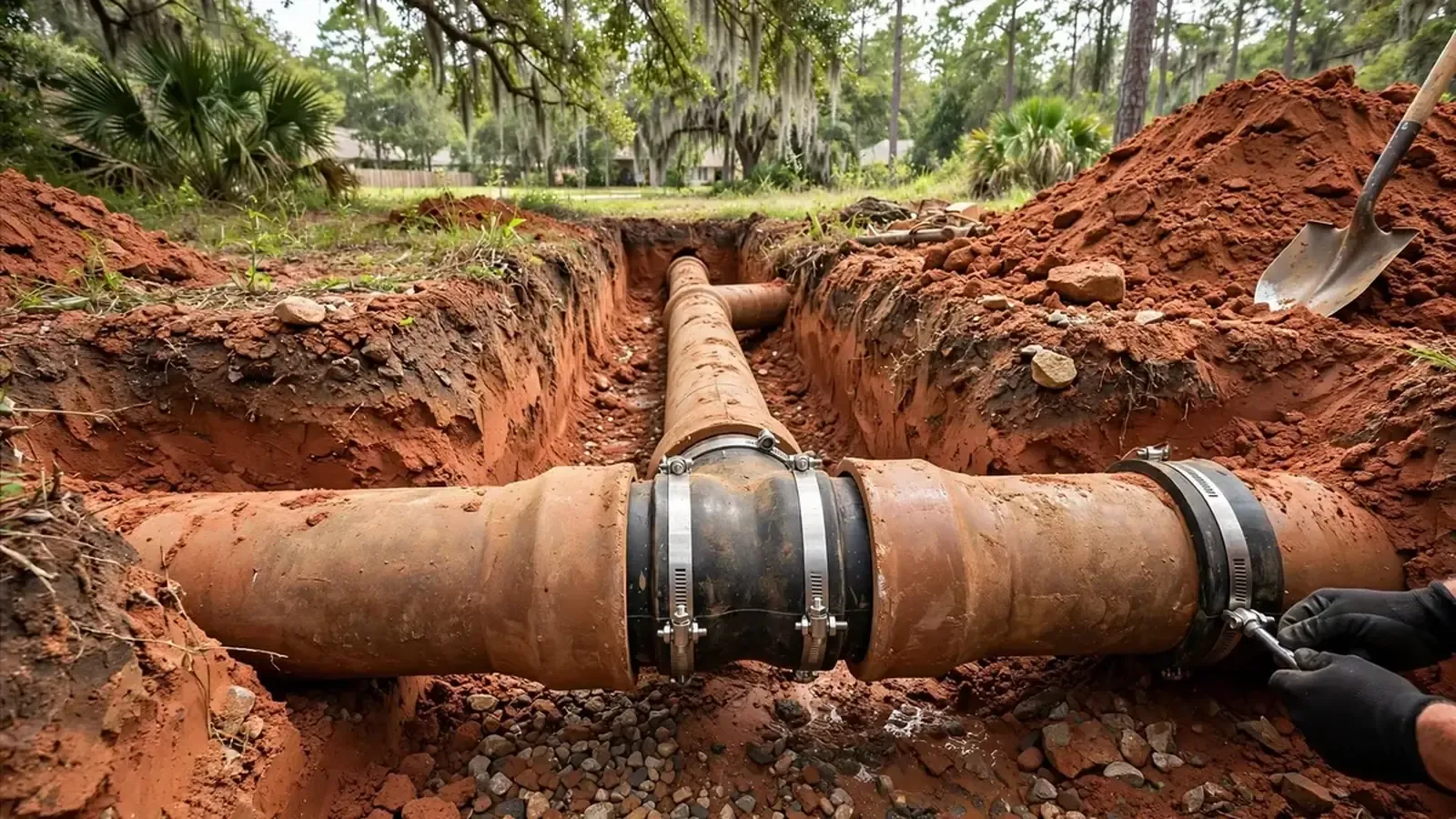
There is no honest "average" for a sewer line repair, because two homes on the same street can need completely different work. The final price follows five things: how long the damaged section is, how deep it sits, what is on top of it, what the pipe is made of, and which repair method fits the damage.
A short spot repair in an open yard sits at one end. A long run under a driveway, patio or mature tree sits at the other.
The only way to turn those factors into a real number is to see inside the pipe first. A camera inspection tells you where the problem is, how far it runs and whether the rest of the line is sound. Then you can compare methods on equal terms, which is the part most homeowners are never shown.
The five factors that set the price
Every sewer quote is a stack of the same building blocks. Knowing them lets you read an estimate line by line instead of reacting to the total.
What moves a sewer line repair quote
- Length of the damaged sectionA two-foot crack and a forty-foot belly are different jobs. More pipe means more material, more labor and more time on site.
- Depth of the lineDeeper pipe means a bigger trench, more soil to move and more shoring. Depth is often the biggest swing factor in an open-cut repair.
- What sits above the pipeLawn is cheap to restore. A concrete driveway, a deck, a retaining wall or a large tree adds demolition, restoration and sometimes extra permits.
- Pipe material and conditionCast iron, clay and plastic fail in different ways. Material decides whether lining is an option and what the replacement pipe will be.
- Repair methodSpot repair, trenchless lining, pipe bursting and full open-cut replacement each carry different labor, equipment and restoration costs.
Most homeowner policies cover sudden damage but often exclude wear, root intrusion and gradual deterioration of the line itself. Ask your insurer before work starts and keep the camera footage, since it documents the cause and the location.
Want your real number? Call (855) 575-2890Repair methods compared
The method matters as much as the damage. A good plumber should be able to explain why one approach fits your line and why the others do not.
| Method | Best for | Main trade-off |
|---|---|---|
| Spot repair (dig and patch) | One short failed section in an accessible spot | Only fixes that section, so the rest of an aging line stays as it was |
| Trenchless lining | Cracks and root intrusion in an otherwise straight, intact pipe | Needs a pipe that is not collapsed or badly offset |
| Pipe bursting | Replacing a failing line with little surface digging | Needs entry and exit pits, and the old pipe must be able to be pulled or split |
| Full open-cut replacement | Collapsed, bellied or badly misaligned pipe, or a short run in open ground | Most disruption to lawn, hardscape and landscaping |
Notice that the cheapest-looking option is not always the cheapest outcome. A spot repair on a line with three more weak joints can mean returning to the same trench within a few years. On the other hand, lining a pipe that has already collapsed does not work at all.
Why depth and access change everything
Digging is the part of a sewer job that scales fastest. Doubling the depth does more than double the work, because the trench has to be wider and safer as it gets deeper. Utility locates, shoring and haul-off of soil all go up with it.
Access is the second multiplier. If the break sits under a slab, a patio or a root-bound oak, the crew either digs around it or avoids digging at all. That is where trenchless methods earn their place, since they can reach the damage through a small access point instead of opening the whole route.
What the camera inspection changes
Before any method is chosen, a sewer camera inspection shows what is really there. It finds the exact break, the pipe material, any offset joints, root masses and low spots that hold water. That means the repair is sized to the damage instead of guessed.
If you suspect a problem but have no confirmed break, start with a sewer camera inspection before you approve any dig. If the line is clogged but not broken, sewer line cleaning may clear it without any repair at all, and the camera can then tell you whether the pipe needs more than that.
Signs the line may need repair, not just cleaning
Cleaning and repair solve different problems. A clog is something in the pipe. A repair is needed when the pipe itself has failed. These signs point toward the second case.
- Drains back up in more than one fixture at once, especially the lowest ones in the house
- The same clog returns within weeks of being cleared
- Gurgling from toilets or tubs when you run the washer
- A soggy patch or sunken strip in the yard along the sewer route
- Sewer odor outdoors that has no other source
If you see standing sewage or smell it indoors, keep people and pets out of the area and avoid using water in the house. A line in that condition is an emergency, not something to price-shop over the weekend.
How to get a quote you can compare
- Get a camera inspection first and ask for the footage or a clear description of the break.
- Ask the plumber which methods fit your pipe and why the others do not.
- Ask what restoration is included, such as sod, concrete or landscaping.
- Ask whether the work needs a permit and who pulls it.
- Compare quotes for the same method and the same length, not just the totals.
- Check that every plumber on your list holds an active license before you sign.
Helena homes and what that means for your line
Helena grew fast. The city went from 3,918 people in 1990 to 20,914 in 2020, so most of the housing outside Old Town is newer. Newer lines are less likely to have the corrosion problems of a very old system, but they can still fail from root growth, settling after heavy construction or a poor joint made at installation.
In Old Town, expect more age in the line and a higher chance that the pipe material itself is the issue. Either way, the question to ask a plumber is the same: is this a defect in one spot or a sign the whole run is wearing out?
Questions to ask before you approve a dig
A sewer repair is one of the larger bills a homeowner faces, so it deserves a short list of questions. None of them are rude, and a good plumber will answer all of them without hesitation.
- What exactly failed, and can I see it on the footage?
- Is the rest of the line in good enough shape to leave alone?
- What happens to the yard, driveway or landscaping, and who restores it?
- What is the plan if the dig finds something the camera did not show?
- Is there a written scope that lists what is and is not included?
The answers tell you more than the total does. A vague answer to the first question is a reason to get a second opinion, and a plumber who is happy to show the footage is usually one who is confident in the diagnosis.
When waiting makes it worse
Small sewer defects tend to stay small only until the next heavy load. A root-filled joint can hold for months and then block completely the weekend you host family. A cracked section leaks into the soil, and over time the ground around it can wash out and drop the pipe further.
That is why a slow drain with a camera-confirmed defect deserves a plan, even if it is not an emergency today. A planned repair lets you compare methods, schedule around your life and choose restoration on your terms. An emergency repair at night leaves far less room to choose.
Call the right people in the right order
Start with the utility if sewage is reaching the street or you suspect the problem is on the public side. For anything inside your property line, call a licensed plumber and ask for a camera inspection first. If you live in Pelham, Alabaster or Chelsea instead, the same sequence applies, and you can find help in Pelham, AL or Alabaster, AL the same way.
When a backup is active, a repair price is not the first question. Stopping the damage is. Once the line is clear and the footage is in hand, our team can walk you through sewer line repair options with a clear price before work starts. Call (855) 575-2890 any time, day or night.
Sewer line repair questions from Helena homeowners
Not exactly, but a camera inspection narrows it a lot. It shows the length of the break, the pipe type and how deep the line sits, which are the biggest drivers. Restoration needs and surprise conditions in the soil can still move the final number a little.
No. Trenchless saves on digging and restoration when the pipe is intact enough to line or burst. If the pipe has collapsed or has a bad belly, it may not be an option. In an open yard with a short run, a simple dig can cost less.
It depends on where the failure is. Call the City of Helena Utilities Board at (205) 663-1670 and ask where the homeowner's responsibility ends. The camera footage helps show which side the break is on.
Often not for age, wear or roots, though sudden damage may be covered. Policies vary, so ask your insurer before work starts and keep the footage and written scope.
Mature trees near the line can send roots into joints and cracks, which causes repeat backups. A camera inspection shows whether roots are the cause and whether lining or replacement is the better answer.