
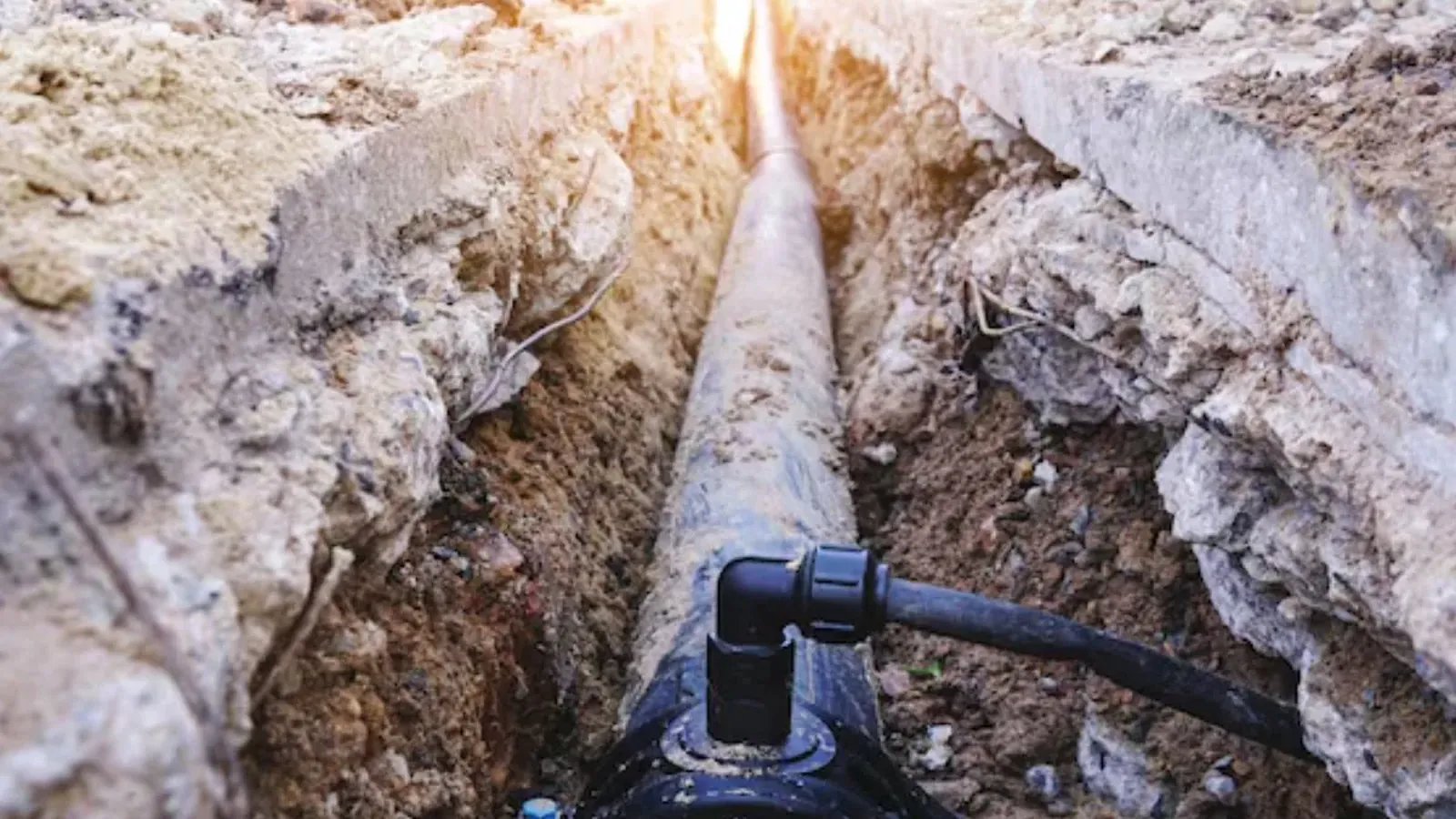
If water is bubbling up in your yard, the house has lost pressure, or the water has stopped altogether, close the main valve at the house and call (855) 575-2890. Our line is open 24/7, including nights and weekends. If the main at the house will not shut, leave the meter alone and call the utility and us. Do not dig yourself, since other buried lines may be nearby.
What the service line is, and who owns which part
The service line runs underground from the water meter to the shutoff valve at your house. It carries every drop of water you use, so a break stops everything at once and a slow leak quietly wastes water and softens the ground around it.
Where the utility's responsibility ends and yours begins varies by system and by address. Do not assume. Ask the City of Helena Utilities Board, at (205) 663-1670, which section is yours before you spend money on a repair. For a leak that sits between the meter and the house, that answer usually decides who calls a plumber.
Signs of a failing line
Not every sign is dramatic. Some are subtle for weeks before a clear failure. Watch for these:
- A green, soggy or sunken patch in the yard when it has not rained.
- Water bubbling up in a driveway, walk or flower bed.
- A meter that keeps moving when every fixture is off.
- A bill that climbs without a change in habits.
- Pressure that drops in the whole house, not just one fixture.
- Muddy or discolored water, or air spitting from taps after the water has been off.
- The sound of running water outdoors or near the meter box.
If the ground around the line is soft and sinking, keep kids and pets off it. Water can wash soil away from under a driveway or walkway before the surface shows any damage.
When the water stops or pressure drops: a night-time emergency
Total loss of water has several causes. The utility may be doing work or have an outage, a valve may be closed, a pipe inside the house may have failed, or the service line may have broken. Before calling, check whether neighbors have water, look at the meter for movement, and confirm the main valve at the house is fully open.
If only your house is affected and the meter shows no movement with a faucet open, call us. The break could be anywhere along the line. If the meter spins but you have no water inside, the loss may be at a break before it reaches the house, and that is an emergency worth a night call.
Low pressure is slower and more confusing. A partly clogged pressure regulator, a partly closed valve, a corroded section or a small leak can all reduce pressure. We check the incoming pressure with a gauge to see whether the problem is in the line, the regulator or the plumbing inside. If the whole street has weak pressure, the Helena Utilities Board is the first call.
| What you see | Probable cause | Next step |
|---|---|---|
| No water, neighbors fine | Break, closed valve or frozen section | Check the main valve, then call |
| Low pressure everywhere | Regulator, partial blockage or a leak | Gauge test at the spigot, then call |
| Wet patch in the yard | Pinhole or joint leak in the line | Close the main and call before digging |
| Meter running, all fixtures off | Leak after the meter or inside | Close the main and see if the meter stops |
| Pressure surge or hammering | Regulator failure | Call during normal hours unless water is flowing |
| Brown water after repairs | Disturbed sediment | Run a cold tap, call if it does not clear |
Finding the leak before anyone digs
Digging blindly turns a small repair into a yard-wide project. We use the meter, pressure testing and listening equipment to narrow down the failure, then confirm the spot before opening the ground. If the line is plastic, sound travels poorly, so pressure testing and other methods carry more of the work.
Before any excavation, call 811 so buried gas, electric and communications lines are marked. Mention your plan to the utility as well, because some repairs near the meter need its involvement. If your property has irrigation, mark the zone valves and tell us where the lines run.
Repair or replace
Not every failed service line needs to be replaced. The choice depends on the age and material of the pipe, how many failures it has had, the depth, and what is above it. Here are the options we usually discuss:
How we usually decide
- Locate the leak and confirm it is on your side of the meter.
- Check the pipe material, depth and condition around the break.
- If the pipe is sound apart from one spot, repair only the damaged section.
- If the pipe is corroded, brittle or has multiple failures, price a full replacement from the meter to the house.
- Choose open trench or a trenchless method based on what is above the line, such as driveway, trees or landscaping.
- Test, backfill and restore, then confirm the meter is still after we finish.
Open trench is the most direct way to replace a line and often the most affordable. Trenchless methods, which pull or burst a new pipe through the old path, disturb less landscaping but suit only some situations. We will describe both, along with what each one leaves behind, so you can choose before work begins.
Why Helena properties are a mixed picture
Helena went from 3,918 residents in 1990 to 20,914 in 2020, and its housing stock reflects that. Growth areas such as Dearing Downs and Old Cahaba are newer than Old Town, but a younger house does not guarantee a trouble-free line. Old Town may have older lines, and a recurring wet spot or falling pressure there deserves a look sooner rather than later.
Lines also pass through varied ground. Roots, shifting soil, and rock can all stress a buried pipe, and heavy equipment above it can crush a shallow one. If you are planning a driveway, fence or pool, tell us where the line runs so the plan does not put new load on it.
What affects the cost of service line repair
- Length and depthA short, shallow section costs less to reach than a long run or one deep under pavement.
- What is above the lineConcrete, a driveway, trees and landscaping each change how the line can be reached and restored.
- Repair or full replacementA spot repair is limited to one section, while a full replacement covers the whole run to the meter.
- Pipe material and fittingsThe pipe type, pressure regulator and connections chosen affect parts and labor.
- Permits and utility involvementSome work requires coordination with the utility or the building department, so check with the Helena building department or the utility.
Homeowners' insurance often does not cover the buried line itself, but some policies and add-on riders do, so ask your insurer. You will see a clear price before work starts, and we explain what is included.
Want your real number? Call (855) 575-2890Water you cannot afford to waste
Buried leaks waste water without any visible sign. The EPA's WaterSense program estimates that the average household loses about 180 gallons per week to leaks, or around 9,400 gallons per year. A service line leak can exceed that, since it runs under pressure around the clock. A bigger bill is often the first hint.
If the meter moves with every tap off, that is worth chasing even when the yard looks dry. For finding the exact spot, see leak detection. If the failed line is older, repiping may be part of the conversation inside the house too.
Before the plumber arrives
- Close the main valve at the house, and confirm whether the meter stops.
- Clear a path to the meter box and the main valve.
- Note where you have seen wet ground, and take photos.
- Mark the position of irrigation lines, sprinkler heads and any buried items you know about.
- Call 811 if digging may be needed, or let us know and we will advise.
- Move vehicles from the driveway if the line runs beneath it.
- Have your utility account number ready in case the utility needs to be contacted.
Questions we hear about water that suddenly stops
When the water is off and the bill is paid, the cause can be the utility, the street, or the line. We help sort out which one. If the problem is on the street side, the utility handles it and we can advise on what to say when you call.
If you are in Pelham or Chelsea, your water provider is different from Helena's, so check which utility serves your address. Our service area page lists where we work.
Service line questions from Helena homeowners
Yes. Our line is open 24/7, and we offer same-day appointments when available. If water is flowing out of the ground, close the main valve at the house and call right away.
It depends on your address and the utility's rules. Ask the Helena Utilities Board at (205) 663-1670 where its responsibility ends before you book a repair.
Look for wet or sunken ground with no rain, a meter that moves with everything off, falling pressure, or an unexplained jump in your bill. Closing the main valve and watching the meter is the first test.
Sometimes. Trenchless methods can limit digging, but they do not fit every line. We look at the pipe, depth and what is above it before suggesting an approach.
It can be. A pressure gauge test at an outdoor spigot helps, and we can check the regulator and the pipes inside as well. If neighbors also have low pressure, call the utility.
Check with the Helena building department or the utility. Rules depend on the work and the section of line.
We will tell you when it is needed. The 811 request is simple to place before digging, and it protects buried utilities from damage.