
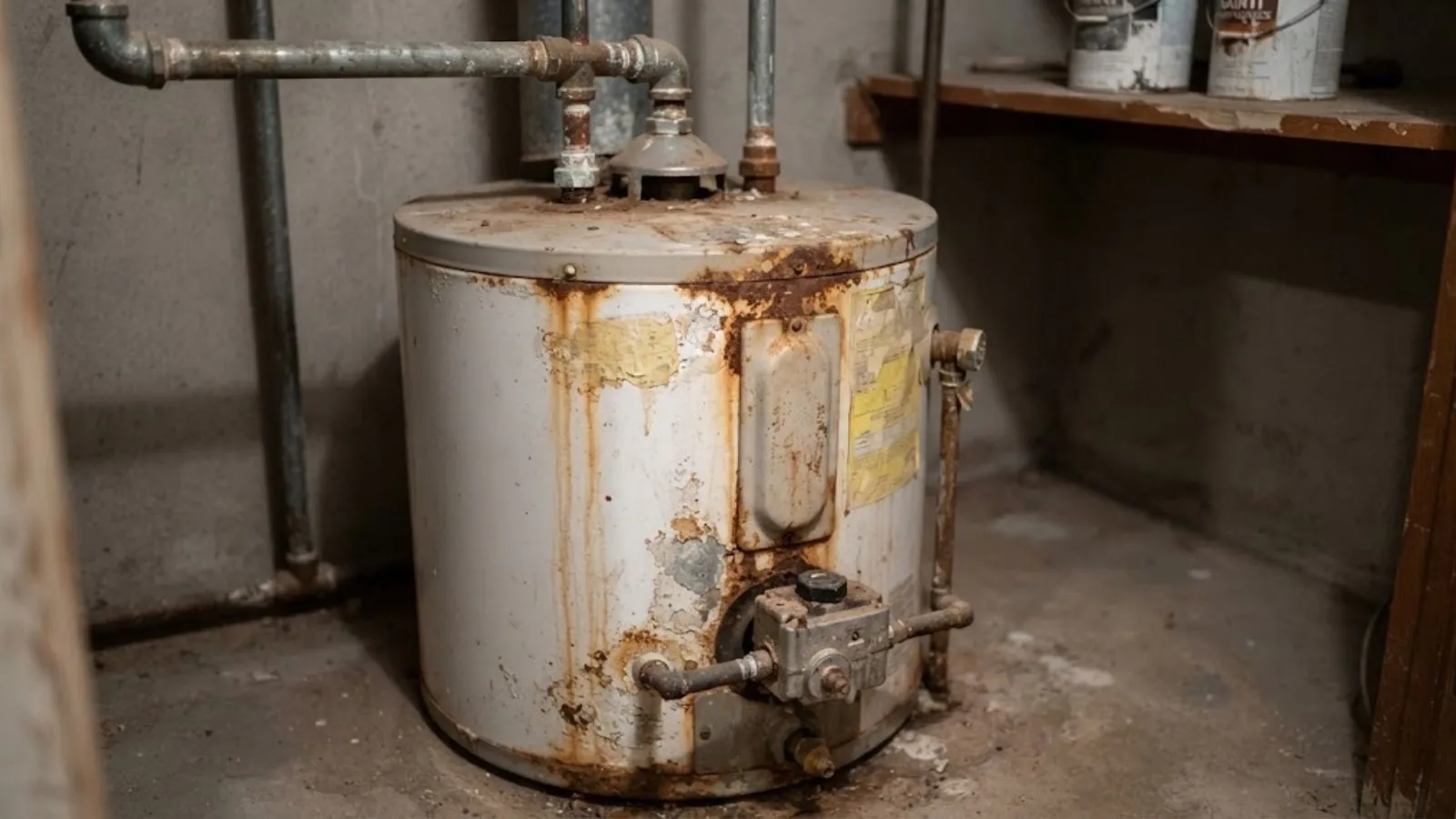
If water is pooling around your tank right now, shut off the cold water supply valve on top of the heater and stop the power. For an electric unit, switch off its breaker. For a gas unit, turn the gas control to off, and if you smell gas, leave the house and call 911 or your gas utility before you call us. Then call (855) 575-2890, because our line answers 24/7, including nights and weekends.
A heater that fails at 2 a.m. does not become easier to deal with by morning. Standing water ruins flooring and drywall quickly, and a cold house full of people still needs showers. We handle replacement as an emergency job when the tank has failed, and we offer same-day appointments when available.
When a failed tank cannot wait until morning
Some failures are an inconvenience and some are a flood in progress. The difference is usually where the water is going. A slow weep from a fitting can often wait for a daytime visit, while water streaming from the base of the tank, or a tank that is hot and leaking at the same time, should be treated as an emergency.
Call right away, day or night, if you see any of these:
- Water spreading across the floor from the bottom of the tank or the drain pan
- Rust-colored water, a bulging tank, or a tank that is hissing or popping loudly
- Water near a gas heater's burner area or near electrical panels and outlets
- A heater in an attic, closet, or upstairs room where a leak can reach ceilings below
- No hot water at all for a household with young children, elderly family members, or anyone with a medical need for hot water
Keep everyone out of a flooded room if the water is near outlets or the panel. Do not walk through standing water to reach a breaker. Shut the power off at the main panel only if you can reach it dry and safely, otherwise call and we will walk you through the next step.
Reading the signs: what your tank is telling you
Most tanks give warning before they quit. The table below matches common symptoms to the likely cause and the usual next step. It is a guide, not a diagnosis, because a plumber has to look at the unit to be sure.
| Symptom | Likely cause | Usual next step |
|---|---|---|
| Water pooling at the base of the tank | Corroded tank shell or failed internal tank | Replacement, since a leaking tank cannot be sealed |
| Leak at the top fittings or supply lines | Loose or worn connection, or a failing valve | Often repairable, so we inspect first |
| Water from the pressure relief valve discharge pipe | High pressure, high temperature, or a worn valve | Inspection, possibly a new valve or an expansion tank |
| Rusty or brown hot water only | Rust inside the tank or a spent anode rod | Replace if the tank is old, service if it is young |
| Rumbling or popping sounds | Sediment baked onto the tank bottom | Flush may help a young tank, an old tank may be near its end |
| No hot water, electric unit | Failed element, thermostat, or breaker | Usually a repair |
| No hot water, gas unit | Pilot or burner issue, thermocouple, or gas control | Often a repair, tank age decides |
The leaking water heater: the most common reason people call
A leaking tank is the call we expect most often for this service. It usually shows up as water in a garage, utility closet, laundry room, or in the metal drain pan under the tank. Some homeowners also notice damp spots on the slab edge or along a wall near the heater, which can point to a supply line leak instead of the tank itself.
The first job is working out where the water is actually coming from. A leak at a fitting or valve can often be repaired. A leak from the tank body means the steel has corroded through, and the only real fix is a new tank. A plumber checks the connections, the relief valve, the drain valve, and the base before recommending anything.
If your heater sits in a finished garage or on the main floor, move stored boxes and anything absorbent away from the tank while you wait. Place a bucket under a drip, and use towels to keep water from reaching drywall. Do not try to drain a hot tank yourself unless you know how, since the water can scald.
Repair or replace: how we decide
Not every failure means a new heater. We weigh the age of the tank, what failed, and what the repair would involve. A young unit with a bad element or thermostat is usually worth repairing. An older unit with a leaking tank, heavy rust, or repeated problems is usually better replaced.
According to the US Department of Energy, storage tank water heaters last about 10 to 15 years. If yours is in that range and has started to fail, putting money into a repair often buys little time. If it is under that range, we will tell you honestly when a repair makes sense. You can read about our repair work on the water heater repair page.
Choosing the replacement: tank, tankless, or heat pump
Replacement is also a chance to choose a better fit. The three common choices behave quite differently, so it helps to see them side by side. The lifespan and efficiency points below come from the US Department of Energy.
| Type | Typical lifespan (US DOE) | Things to weigh |
|---|---|---|
| Storage tank | About 10 to 15 years | Lowest upfront cost of the three, bulky, keeps a reserve of hot water |
| Tankless | About 20 years | Heats on demand, 8% to 34% more efficient than storage depending on use, needs proper venting and gas supply sizing |
| Heat pump | About 10 to 15 years | Very efficient in the right space, needs room and airflow around the unit |
If you want to stay with a tank, replacement is often the quickest option because the connections already exist. Switching to tankless means checking the gas line size, venting, and water flow, so it is better planned than rushed. We cover that in more detail on our tankless water heater page.
Gas, electric, or changing fuel
Most homeowners replace like for like. A gas heater is swapped for a gas heater and an electric one for an electric one, which keeps the job simple. Changing fuel type is possible but adds work, such as a new gas line, a vent, a new circuit, or a condensate drain.
Some callers ask about moving from a gas tank to a heat pump unit. That can make sense, but it depends on your space, your electrical panel, and your priorities. We will talk it through, and if a change would involve permits or code questions, check with the Helena building department about local requirements before the work is scheduled.
What to do before the plumber arrives
These steps are safe for most homeowners and can limit damage while you wait.
Before we arrive
- Turn off the cold water supply valve to the heater. It is usually on the pipe entering the top of the tank.
- Shut off power at the breaker (electric) or turn the gas control to off (gas). Leave the house and call 911 or your gas utility if you smell gas.
- Move belongings away from the tank and soak up standing water with towels, a mop, or a wet vacuum.
- Take a photo of the heater label and the leak, which helps if you file a homeowners insurance claim.
- Clear a path to the heater so the plumber can reach it, and make sure lighting is on.
No hot water: what is going on
A tank that is not leaking but has stopped producing hot water is a different problem. For electric units, the cause is often a tripped breaker, a bad heating element, or a failed thermostat. Gas units may have lost the pilot, or have a problem with the thermocouple or gas control valve.
Check that the breaker has not tripped and that the gas control is set to on before you call. If those look normal, the cause is inside the unit. Some of these are repair jobs and some mean the tank is done, and our plumber will explain which applies after looking at the heater.
What affects the price of a replacement
We give you a clear price before work starts. Final cost depends on the job, so here are the factors that move it up or down.
What affects the cost of replacing a water heater
- Tank size and typeA larger tank, a tankless unit, or a heat pump unit costs more than a standard 40 or 50 gallon tank.
- Fuel and ventingGas units need a safe vent path and gas connections. Changing fuel or rerouting a vent adds work.
- Condition of the old connectionsCorroded valves, supply lines, or a worn drain pan may need replacing at the same time.
- Access and locationAttics, closets, and tight utility rooms take longer than an open garage.
- Add-onsAn expansion tank, a new shutoff valve, or a drain pan are sometimes added to protect the new unit.
If a leak damaged floors, drywall, or belongings, your homeowners insurance may cover part of the water damage. Replacement of the heater itself is usually treated as normal wear, but policies differ, so ask your insurer. We can provide a written description of the work for your claim.
Want your real number? Call (855) 575-2890Water heaters in Helena homes
Helena grew from 3,918 people in 1990 to 20,914 in 2020, and most of that building happened after 2000. That means many houses here have heaters installed during the 2000s and 2010s, and a lot of those units are now at or past the 10 to 15 year range the Department of Energy gives for storage tanks.
If your home is in a subdivision like Dearing Downs or Old Cahaba and your original heater is still running, it is worth knowing its age.
Look for the manufacture date on the label or in the serial number. If it is 12 years or older, plan for replacement before it fails at a bad time, such as during a holiday weekend. Old Town Helena homes can have older plumbing around the heater too, which we check at the same visit.
Water hardness varies by utility, and we do not know the figure for your home. Ask the City of Helena Utilities Board at (205) 663-1670 or test your tap, because hard water can leave sediment that shortens a tank's life. A flush now and then helps, and a plumber can show you how.
What happens when we replace the heater
Here is the usual order of work once we arrive.
- We confirm the failure and show you why the old unit cannot be saved, if that is the case.
- We give you a clear price before work starts and let you choose between the options that fit.
- We shut off water and power or gas, drain the old tank, and disconnect it.
- We set the new heater, connect water lines, vent (if gas), and fit the relief valve and discharge line.
- We fill the tank, purge air, restore power or gas, and test for leaks and temperature.
- We take the old unit away and walk you through the controls and the shutoff valves.
Setting the water temperature is part of the visit. Many people leave a heater at a very hot setting, which wastes energy and raises the scald risk for children. We will help you pick a setting that fits your household.
Related plumbing work and where we serve
A failed heater sometimes comes with other problems, like a leaking supply line or a damaged floor drain. For leaks inside walls or under slabs, see leak detection, and for a planned new unit with no emergency, see water heater installation. If the pipe feeding your heater has burst, go to burst pipe repair.
We serve Helena and nearby towns, including Pelham and Alabaster. Call the same 24/7 line from any of them.
Water heater replacement questions
Yes. Our emergency line answers 24 hours a day, every day, including nights, weekends, and holidays. We offer same-day appointments when available, and we can tell you what to shut off while you wait.
Age and the type of failure decide it. A leak from the tank body means replacement. A bad element, thermostat, or pilot is often repairable. The US Department of Energy puts storage tank life at about 10 to 15 years, so a unit near the end of that range is usually better replaced.
A like-for-like swap is often a few hours of work, though it depends on access, venting, and any problems found when the old unit comes out. Changing fuel type or moving to tankless takes longer. We will tell you what to expect before we begin.
Often yes, but it depends on your space, your electrical panel or gas line, and venting. A heat pump unit needs room and airflow, and a tankless unit needs the right gas supply and vent. We can look at your setup and tell you what the job would involve.
We do not state local permit rules here because they can change. Check with the Helena building department about what applies to your address. We will tell you if your job looks like one that needs it.
Shut off the cold water supply to the heater, turn off its power or gas, and contain the water with towels or a wet vacuum. Leave the house and call 911 or your gas utility if you smell gas. Then call our 24/7 line.
It might. Many homeowners policies cover sudden water damage but not the heater itself, which is treated as wear. Photograph everything and ask your insurer what is covered.