
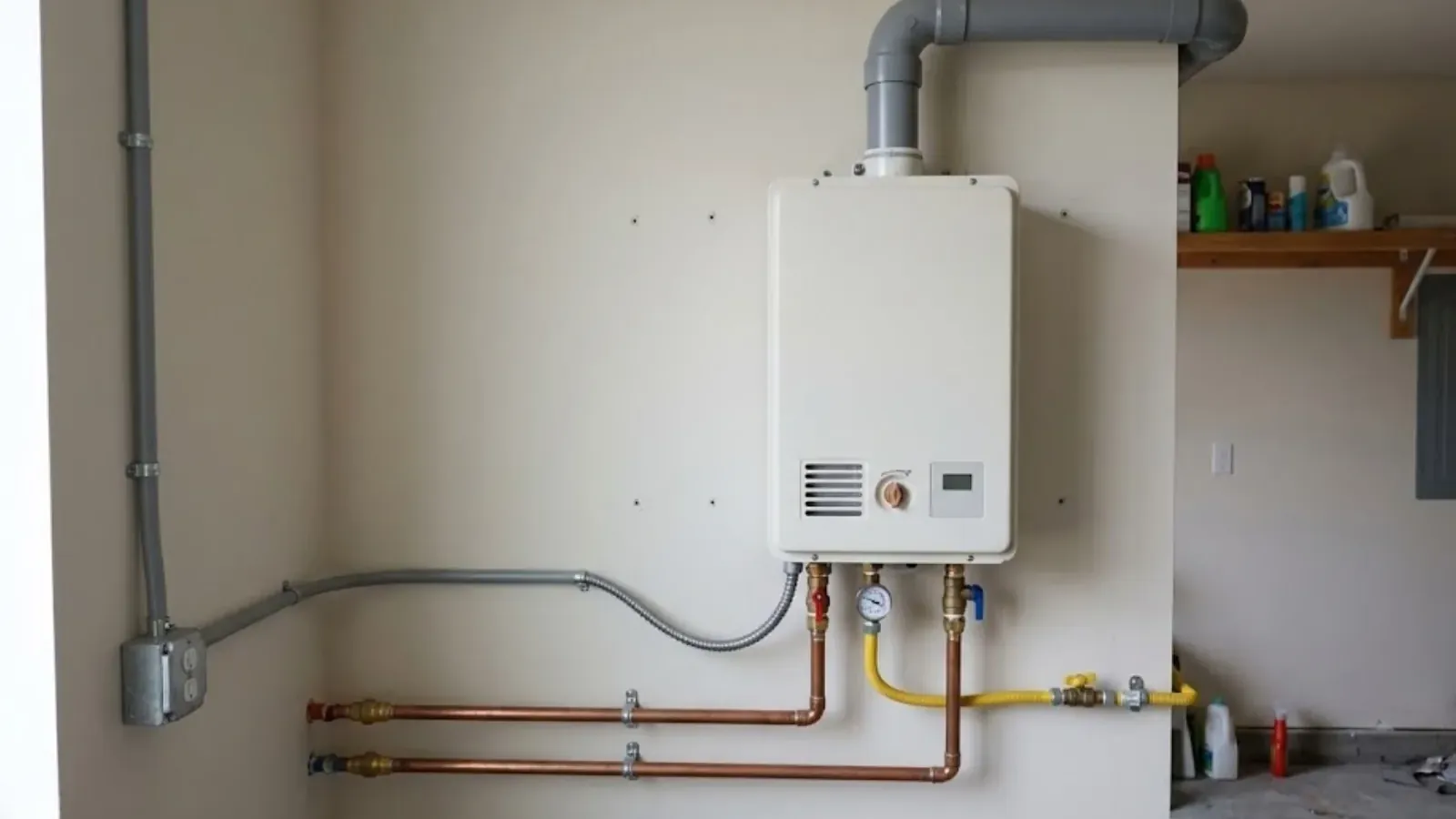
A tankless water heater warms water only when you open a tap, so there is no tank of stored hot water to run out. It costs more to install than a standard tank, but it takes less space and can lower energy use. Call (855) 575-2890 if you want to install one, replace an older one, or fix one that is throwing a code or running cold.
Tankless units are more particular than tanks. They need the right gas line size, a correct vent, and clean water inside the heat exchanger. That is why service and installation both need a plumber who works with these units regularly.
How a tankless heater works
When you open a hot tap, flow sensors detect the water moving and fire a gas burner or energize electric elements. Water passes through a heat exchanger and leaves at the set temperature. When you close the tap, the unit shuts off.
This is why gas tankless units need a bigger gas supply than a storage tank. The burner has to heat the full flow all at once. Electric tankless units draw a lot of power for the same reason, so they need heavy-duty circuits and a panel that can handle the load.
Is tankless worth it for your home?
The honest answer depends on how you use hot water. According to the US Department of Energy, tankless water heaters last about 20 years and are 8% to 34% more efficient than storage tanks, depending on how much hot water you use. Homes that use a modest amount of hot water see the biggest percentage gain, while heavy users see less.
| Point | Tankless | Storage tank |
|---|---|---|
| Lifespan (US DOE) | About 20 years | About 10 to 15 years |
| Efficiency (US DOE) | 8% to 34% better, depending on use | Baseline |
| Hot water supply | Continuous, limited by flow rate | Limited by tank size, then recovery |
| Space | Wall mounted, small | Floor standing, larger |
| Upfront cost | Higher | Lower |
| Installation needs | Gas line size, vent, or high-amp circuit | Standard connections |
The biggest drawback is that a tankless unit can only heat so much water at once. If three showers and a dishwasher run together, a small unit may fall behind. Sizing it to your household matters, and we cover that during the quote.
Tankless water heater installation
Installing a tankless unit takes more than hanging it on a wall. The gas line may need to be larger, the vent has to be the right material and size, and a condensate drain is needed for high-efficiency models. Electric units may need a new breaker and heavy wiring.
When you switch from a tank, the old connections rarely line up with the new unit. We plan the gas supply, the vent path, the water lines, and the placement before work begins. For a standard tank swap without these changes, see water heater installation.
Check with the Helena building department about permits and inspection requirements for your address, since a gas and venting job may come with local rules. We will tell you what we see on our end.
How a tankless install goes
- We look at your current heater, gas line, vent, panel, and the space for the new unit.
- We size the unit to your flow needs and recommend a model.
- You get a clear price before work starts, including gas, vent, and electrical changes.
- We remove the old heater, run the new gas or electric supply, and mount the unit.
- We connect water lines, isolation valves, and venting, then test for leaks and combustion.
- We set the temperature and show you the controls and any error code display.
Tankless water heater repair
Tankless problems are often about water quality, flow, or a safety sensor. Common complaints include a unit that delivers lukewarm water, a code that shows on the display, a unit that shuts off mid-shower, and a burner that will not light. Many of these are fixable without replacing the unit.
Error codes vary by brand, so the first step is writing down the code and the model number. A code can point to a blocked vent, an ignition issue, a water flow problem, or a scale-clogged heat exchanger. We read the code, test the unit, and explain the fix before we do it.
Leaks are the exception. A leak at a fitting or isolation valve can often be repaired, but a leak from inside the heat exchanger usually means that part has failed. If the unit has been in service a long time, we will go over repair against replacement honestly.
Tankless flush and descale service
A flush is the single most useful maintenance task for a tankless heater, and it is the one most homeowners miss. Minerals in the water gradually coat the inside of the heat exchanger. That coating reduces flow, causes error codes, and makes the unit work harder.
A flush circulates a descaling solution, usually white vinegar or a manufacturer-approved cleaner, through the heat exchanger using a small pump and the isolation valves. Then we flush the system with clean water, check the inlet screen, and test the unit. Many manufacturers recommend doing it on a regular schedule, and the right interval depends on your water.
If your tankless was installed without isolation valves, we can add them so future flushes are quick and easy. Some callers tell us a previous plumber declined to service their unit. We service tankless heaters and can tell you whether yours needs a flush, a part, or a replacement.
Signs your tankless unit needs attention
Look for these signs, and call us if any of them show up:
- Hot water that runs cool or inconsistent, especially at low flow
- Error codes on the display or blinking lights
- A louder than normal sound, like rumbling or kettling from inside the unit
- Longer waits for hot water at the tap
- A burner that clicks but does not light, or soot near the vent
- Visible scale or white buildup at the water inlet screen
A unit that shows these signs for months can lose efficiency and may need a more expensive repair later. Flushing early is usually cheaper than waiting for the heat exchanger to fail.
Helena water and tankless heaters
Mineral content in your water is the main reason tankless units need regular flushing. We do not know the hardness at your address, and Helena water does not come with a number we can promise. The City of Helena Utilities Board at (205) 663-1670 can tell you about your supply, or you can test a tap sample at home.
Helena has grown fast since 1990, from 3,918 people to 20,914 in 2020, and many newer homes have gas lines sized for a standard tank. If you are thinking about tankless, the gas line is the first thing we check. In Old Town Helena, older plumbing may add other updates to the job.
If you plan to stay in your home a long time, which fits the 91.1 percent owner-occupied rate here, the 20 year lifespan of tankless is a real advantage. If you may sell soon, a standard tank can make more sense.
What affects the price
Every tankless job is different, so we give you a clear price before work starts. These are the main factors.
What affects the cost of tankless service
- Unit size and brandLarger or higher-capacity units cost more, and some brands have pricier parts.
- Gas line and ventingA bigger gas line or a new vent adds materials and labor.
- Electrical workElectric units may need a new breaker or heavier wiring.
- Water condition and ageHeavy scale can mean a longer flush or a part replacement.
- AccessA tight or hard-to-reach location takes more time.
Insurance does not usually pay for tankless installs or routine flushes. If a leak from the unit damaged your home, your homeowners policy may cover that damage, so ask your insurer.
Want your real number? Call (855) 575-2890Related work and where we serve
If your old tank has failed and you are weighing a switch, see emergency water heater replacement. For a heater that is acting up but not yet dead, our water heater repair page explains what we can fix.
We serve Helena and nearby towns, including Alabaster and Pelham.
Tankless water heater questions
The US Department of Energy puts the lifespan at about 20 years, compared to about 10 to 15 years for a storage tank. Regular flushing helps it reach that range.
According to the US Department of Energy, tankless units are 8% to 34% more efficient than storage tanks depending on how much hot water you use. Low-use homes see the largest gains.
Yes. Minerals build up inside the heat exchanger and cause codes, low flow, and wear. A flush with a descaling solution removes the buildup. Isolation valves make the job quick, and we can add them if yours does not have them.
Write down the code and the model number. Check that the gas supply and vent are not obstructed, then call us. Codes can point to scale, ignition, flow, or vent problems, and the fix depends on which.
Yes. We can inspect it, read the code, flush it, and replace worn parts. If we cannot repair a specific brand, we will say so and tell you what the options are.
Not always. Tankless burners need more gas volume than a tank. We check the line size, the meter, and the run length before recommending a model.
Check with the Helena building department about what applies to your address. We do not state local permit rules on this page because they can change.