
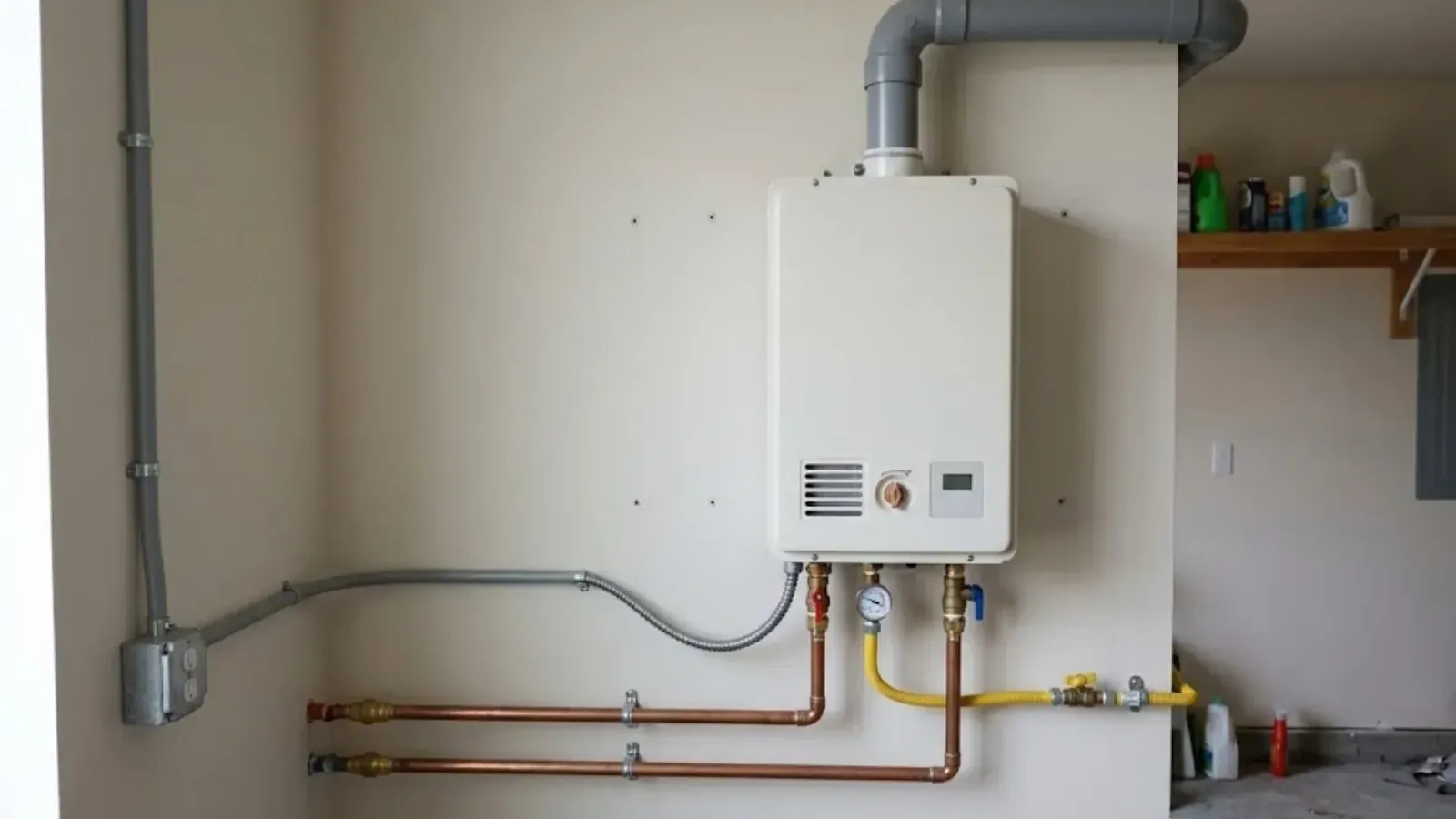
Yes, a tankless water heater can leak. The risk is different from a tank unit, though. There is no large tank holding dozens of gallons that can fail all at once, so a tankless leak is usually a drip or a seep from one specific part. That makes it easier to catch early and usually smaller in volume.
The usual suspects are loose or worn pipe fittings, a failed valve, a clogged or cracked condensate drain on a condensing model, and a damaged heat exchanger. Scale from mineral buildup can also cause trouble. Any of these can show up as wet floor, a damp wall, error codes or lower hot water output.
Where tankless units tend to leak
Tankless heaters have more plumbing connections than people expect. Hot and cold water lines, a gas line on gas models, a pressure relief valve, isolation valves and a condensate drain all attach to a compact box. Any of those joints can fail.
| Where the water shows | Likely cause | What to do |
|---|---|---|
| At the pipe connections on the bottom | Loose or worn fitting or union | Shut off water and have the joint resealed |
| At the isolation or service valves | Worn valve packing or O-ring | Replace the valve or O-ring |
| From the pressure relief valve line | Pressure or thermal problem | Call a plumber, do not plug the valve |
| Condensate drain or line is wet | Blocked or cracked condensate drain | Clear the line and check neutralizer |
| Water inside the cabinet | Failed heat exchanger or internal seal | Shut down and call for service |
| Wet wall behind the unit | Pinhole in a nearby pipe | Locate the leak and repair the pipe |
What to do the moment you see water
A small leak from a tankless unit is still a risk because the unit has power or gas. Treat it with care and keep it simple.
Safe first steps for a leaking tankless unit
- Turn off the power to the unit at the switch or breaker. For gas models, close the gas valve at the unit if you can do it safely.
- Close the water supply valves on the unit. If you cannot find them, close the main water valve for the house.
- If you smell gas, leave the building and call 911 and the gas utility's emergency line from outside. Do not use switches or flames.
- Place a towel or pan under the leak and keep people away from wet floors near electrical parts.
- Take a photo of the unit's model plate and any error code on the display.
- Call a plumber and describe where the water appears.
Electricity and water are a bad mix. If the unit is sitting in standing water, do not touch the electrical parts, and do not reset the breaker until the area is dry and checked.
Why mineral scale matters
Scale is a leading cause of problems in tankless units. Minerals in the water coat the inside of the heat exchanger and the narrow passages, which make the unit work harder and can shorten its life. The unit can overheat, set off error codes and eventually leak at a seal or crack.
Most makers recommend flushing the unit on a schedule. How often depends on your water, so check the manual and ask the utility or test your tap. We do not quote a Helena hardness figure, and you should be careful of anyone who does without a source. A flush costs far less than a failed heat exchanger.
Condensate problems on high-efficiency models
Condensing tankless units cool exhaust gas enough to produce acidic water, which drains through a small line. If that line clogs, freezes or cracks, the water backs up and can drip from the unit or the floor beneath.
This is a small part with a big result, and it is easy to overlook in a closet or garage. A plumber can check the drain, the trap and any neutralizer cartridge. If your unit has a neutralizer, the manual says how often it needs replacing.
Leak versus condensation
Not every wet spot is a leak. A cold pipe can sweat on a humid day, and a condensing unit makes water by design. The test is to dry everything, then watch. Water that returns in the same spot while the unit is idle is a leak. Water that appears only when the unit fires or when the air is humid may be condensation.
If you cannot tell, treat it as a leak. A plumber can confirm with a pressure test or by tracing the water to its source, and may use leak detection tools if the water is coming from a hidden line.
Repair or replace
Tankless units last a long time compared with tank heaters. The US Department of Energy puts the life of a tankless water heater at about 20 years, and notes these units are 8 percent to 34 percent more efficient than storage tank models depending on use. That long life makes repair worthwhile for most leaks, since a fitting, valve or condensate part is a small job compared with a new unit.
A cracked heat exchanger is the main exception, especially on an older unit. In that case, compare the repair cost against a new tankless water heater with a warranty. If the unit has been in service for most of its expected life, replacement may be the better choice.
What to note for the plumber
- Brand, model and age from the data plate
- Gas or electric model
- Where exactly the water appears and when
- Any error codes on the display
- Whether the unit was flushed and when
- Whether hot water output has dropped
- Whether you have a water softener
Helena homes and tankless units
Helena grew from 3,918 people in 1990 to 20,914 in 2020, and newer homes in the city are the most likely to have a tankless heater added or built in. A newer install is often still within its warranty, so check the paperwork before you pay for a repair. If the unit was added during a remodel, ask who did the work and whether a flush schedule was set.
In Old Town, where homes are older, the bigger risk is the old pipe feeding the unit. A tankless heater is only as good as the plumbing it connects to, so check the supply lines too.
Who to call
A leak at a tankless unit is a good job for a licensed plumber who works on that brand. If it is a gas model with a gas smell, the first call is 911 and the gas utility.
After that, call (855) 575-2890 for repairs, a flush or a replacement quote with a clear price before work starts. For related fixes, our water heater repair team handles tank and tankless units, and we serve Pelham, AL and Calera, AL as well as Helena.
Tankless water heater leak questions from Helena homeowners
It can be, because the unit has power or gas and sits near water. Shut off power and water, and if you smell gas, leave and call 911 and the gas utility.
The bottom has the pipe connections, valves and condensate drain, which are the usual leak points. A plumber can tell which one it is in a short visit.
Follow your manual. The right interval depends on your water, and we do not state a Helena hardness figure, so ask the utility or test your tap.
Yes. The Department of Energy lists about 20 years for tankless and about 10 to 15 years for storage tanks.
It is better to shut it down until a plumber checks it. Small leaks grow, and water near the electrical parts is a risk.