
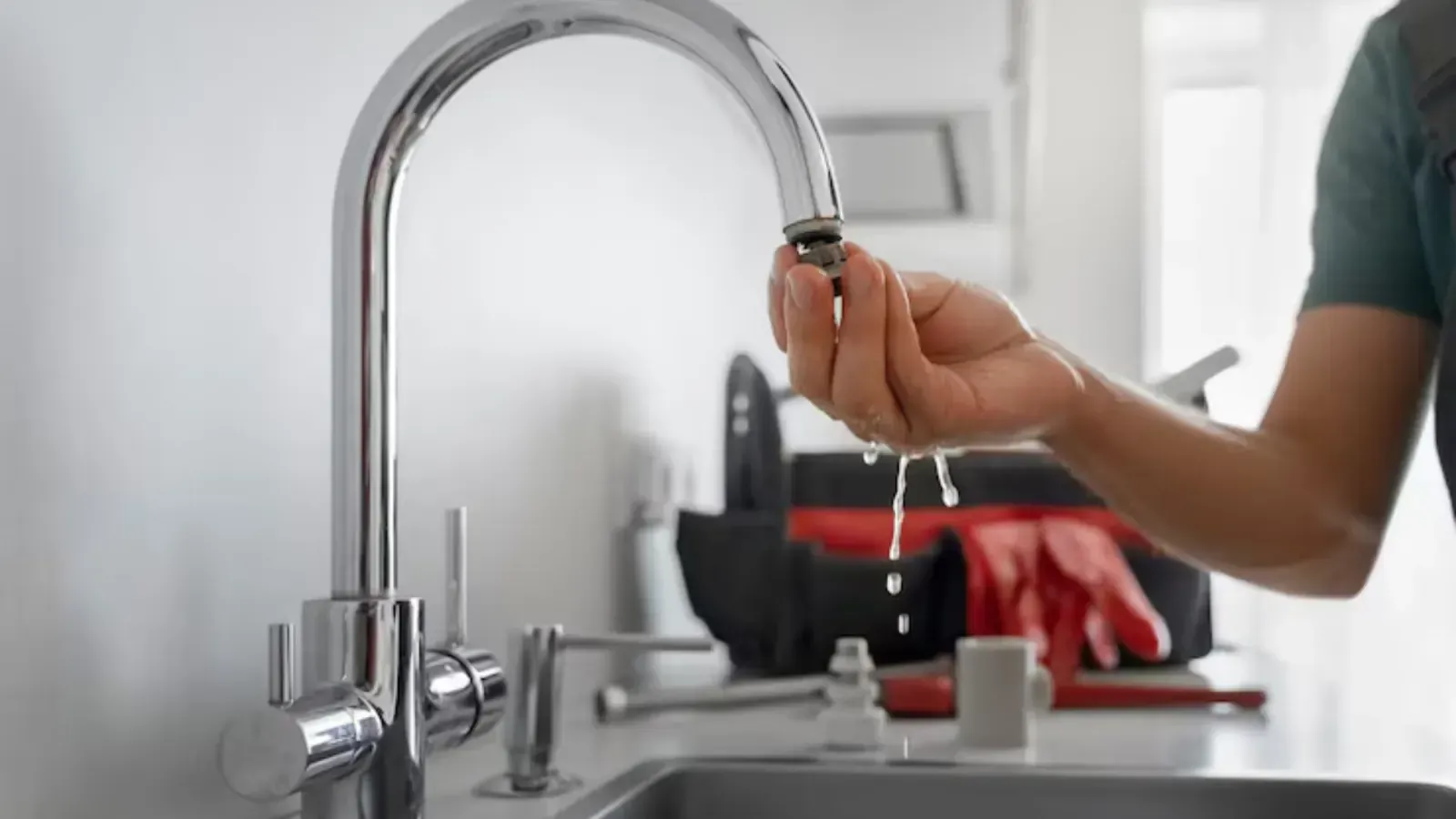
A kitchen faucet leaks from one of four places: the spout, the handle, the base, or the supply lines and valves underneath. Each spot points to a different worn part. A drip from the spout usually means a worn cartridge, washer or seat. Water around the handle means worn seals. Water pooling around the base or inside the cabinet means a failed seal, a loose connection or a split supply line.
Start by watching where the water first appears, then dry everything with a towel and check again. That one test tells you whether you have a ten-minute fix or a job for a plumber, and it tells you whether the water is reaching your cabinet floor.
Match the leak to the cause
Use the table below as a first guide. It is not a diagnosis for every faucet brand, but it covers the common patterns.
| Where you see water | Likely cause | Typical fix |
|---|---|---|
| Drip from the spout tip, constant | Worn cartridge, washer or valve seat | Replace the cartridge or seat parts |
| Drip only when the handle is on | Worn internal seal | Replace the cartridge or O-rings |
| Water around the handle base | Worn O-ring or loose packing nut | Replace seals and tighten the nut |
| Water at the faucet base on the counter | Failed base seal or loose mounting | Replace the seal or tighten the nut from below |
| Wet cabinet floor under the sink | Loose or split supply line, shutoff valve leak | Replace the line or valve |
| Weak flow plus a leak at the spout swivel | Worn spout O-rings | Replace the O-rings |
Stop the water first
Do this before you start guessing at parts. A small drip can ruin a cabinet floor if it runs for a few weeks, and a failed supply line can drain a lot of water in a short time.
Quick steps when a kitchen faucet starts leaking
- Close the two shutoff valves under the sink by turning them clockwise. If they will not move, close the main water valve for the house.
- Open the faucet to drain the lines and confirm the water is off.
- Dry the faucet and the cabinet, then place a towel in the cabinet floor.
- Turn the water back on briefly and watch where the first drop forms.
- Take a photo of the faucet brand and model, which is often on the base or under the sink.
- Decide whether to repair, replace or call, using the sections below.
Spout drips: the cartridge or seat
The most common kitchen faucet drip comes from the cartridge in a single-handle faucet, or a washer and seat in an older two-handle one. These parts wear from years of turning and from mineral deposits in the water.
Cartridges are model-specific, so you need the faucet's brand and model before you buy one. A wrong cartridge may fit but still leak. If your faucet has no visible brand, a plumber can usually identify it by removing the handle and cap.
Handle and base leaks
Water around the handle means the seals inside the handle body are worn or the packing nut is loose. This is often a simple repair, but corroded fittings can make it harder than it looks, and forcing a stuck part can crack the faucet body.
A leak at the base is more serious. It often means the mounting is loose, the seal has failed, or water is running down the inside of the faucet body into the countertop hole. If the counter is stone or laminate, repeated wetting can damage the edge. Shut the water and look underneath for staining.
Under the sink: supply lines and shutoff valves
If the cabinet floor is wet, check the supply lines first. Flexible braided lines can fail at the fittings or split inside the braid with no outside warning. Shutoff valves can also seep at the stem or the connection, particularly when they have not been turned in years.
Replace a leaking supply line instead of tightening it over and over, and test shutoff valves by turning them gently. If a valve will not close or starts to leak when you touch it, a plumber should replace it so you have a working shutoff. A faucet job often goes faster and safer when the valves under the sink work properly.
Repair or replace
Repairing is the right call for a newer faucet with a worn cartridge. Replacing is better when the faucet is old, corroded, pitted or has had a repair before. Some faucets are cheap enough that repair parts and labor approach the price of a new fixture. Others are high-end and worth fixing.
Ask your plumber about the faucet's age, parts availability and finish condition. Also consider whether you are planning a countertop change or a sink swap soon, since replacing the faucet at the same time saves a visit.
For a straightforward fix or a swap, our faucet repair team can check the parts and give a clear price before work starts. If the leak comes from a pipe behind the wall rather than the faucet, leak detection is the right service.
What to check before calling a plumber
- Is the water shut off at the sink valves, and did it stop?
- Where does the first drop of water appear?
- Is the cabinet floor wet, soft or stained?
- Can you find the faucet brand and model?
- Does the leak happen only when the faucet is on, or all the time?
- Is the faucet loose on the counter when you press it?
- Have you noticed a higher water bill?
Helena homes and kitchen faucets
A large share of Helena homes outside Old Town were built after 2000, since the city grew from 10,296 people in 2000 to 20,914 in 2020. Original kitchen faucets in those homes are often builder-grade, and that means a worn cartridge is common once the fixture is a decade or two old.
Replacing a builder-grade faucet with a better one is often a simple upgrade, and the tie to a repair is clear: if the part is cheap and the faucet is solid, repair. If both are low quality, replace.
In Old Town, expect older shutoff valves and more corrosion at the fittings. That is where a replacement of the valves during the faucet job pays off.
When to call
Call a plumber if water is running into the cabinet, if the shutoff valves will not close, if the faucet is corroded, or if you are not sure where the water comes from. We serve homes across Helena, and neighbors in Alabaster, AL and Chelsea, AL can reach us the same way. Call (855) 575-2890 and describe where the water shows up, which makes the visit quicker.
Kitchen faucet leak questions from Helena homeowners
The cartridge, washer or seat inside has worn. It usually needs new internal parts, or the whole faucet is replaced if it is old.
If a braided line leaks at a fitting, replacing it is usually safer than cranking down on a tired fitting. Tightening a split line does nothing.
Yes. EPA WaterSense says household leaks waste about 180 gallons per week on average. Check your bill from the City of Helena Utilities Board against your usual pattern.
If the water appears only when the faucet is on, the faucet is the source. If the cabinet stays wet when the faucet is off, check the supply lines and valves, then the drain.
It can be, because water slips under the faucet into the countertop and cabinet. Shut the sink valves until it is fixed.