
A tub that drains slowly but does not seem clogged usually has one of five problems. It may be a partial blockage, a stopper that does not open fully, buildup in the trap, a blocked plumbing vent, or an early sign of trouble in the main line. The key is that "not clogged" rarely means "nothing in the pipe."
Work through the causes from simplest to hardest. Start at the drain opening, move to the stopper and overflow, then look at what else in the house drains slowly. That pattern tells you whether the problem is local to the tub or part of something larger.
Sorting the causes by symptom
Use the table to match what you see to the most likely cause. Each row has a different next step, and some are easy to try before you call.
| What you notice | Likely cause | First thing to try |
|---|---|---|
| Water drains slowly from day one, steady | Partial hair and soap blockage | Remove the stopper and clean the strainer by hand |
| Slow only with the stopper in the up position | Stopper or linkage out of adjustment | Adjust the pop-up lever and linkage |
| Gurgling sounds as the tub drains | Vent or partial blockage pulling air | Check other fixtures and call a plumber if repeated |
| Tub and sink both slow | Shared branch line partly blocked | Try a cleaning of the branch |
| Tub slow, toilet gurgles when tub drains | Main line problem | Stop using water and call a plumber |
| Standing water in the shower floor drain too | Lower main line partly blocked | Call a plumber for line cleaning |
Start with the stopper and overflow
Many tubs have a pop-up stopper, a lift-and-turn stopper or a trip-lever assembly in the overflow plate. Each can fall out of adjustment, which leaves the drain only partly open. If the stopper looks open but the water drains as if through a straw, it may be catching on the linkage.
Pull the stopper and look at it. Hair wraps around the stem more than anywhere else, and a mat there slows everything. Clean it, reset it and test with a few inches of water. If the stopper has a trip lever, check that the plunger inside the overflow tube is not coated in debris or stuck halfway.
The partial blockage you cannot see
Hair and soap scum can narrow a pipe without sealing it. The drain still works, but slowly. Because the opening looks fine, people assume the pipe is clear. A plunger or a hand drain tool often clears this layer when used with patience.
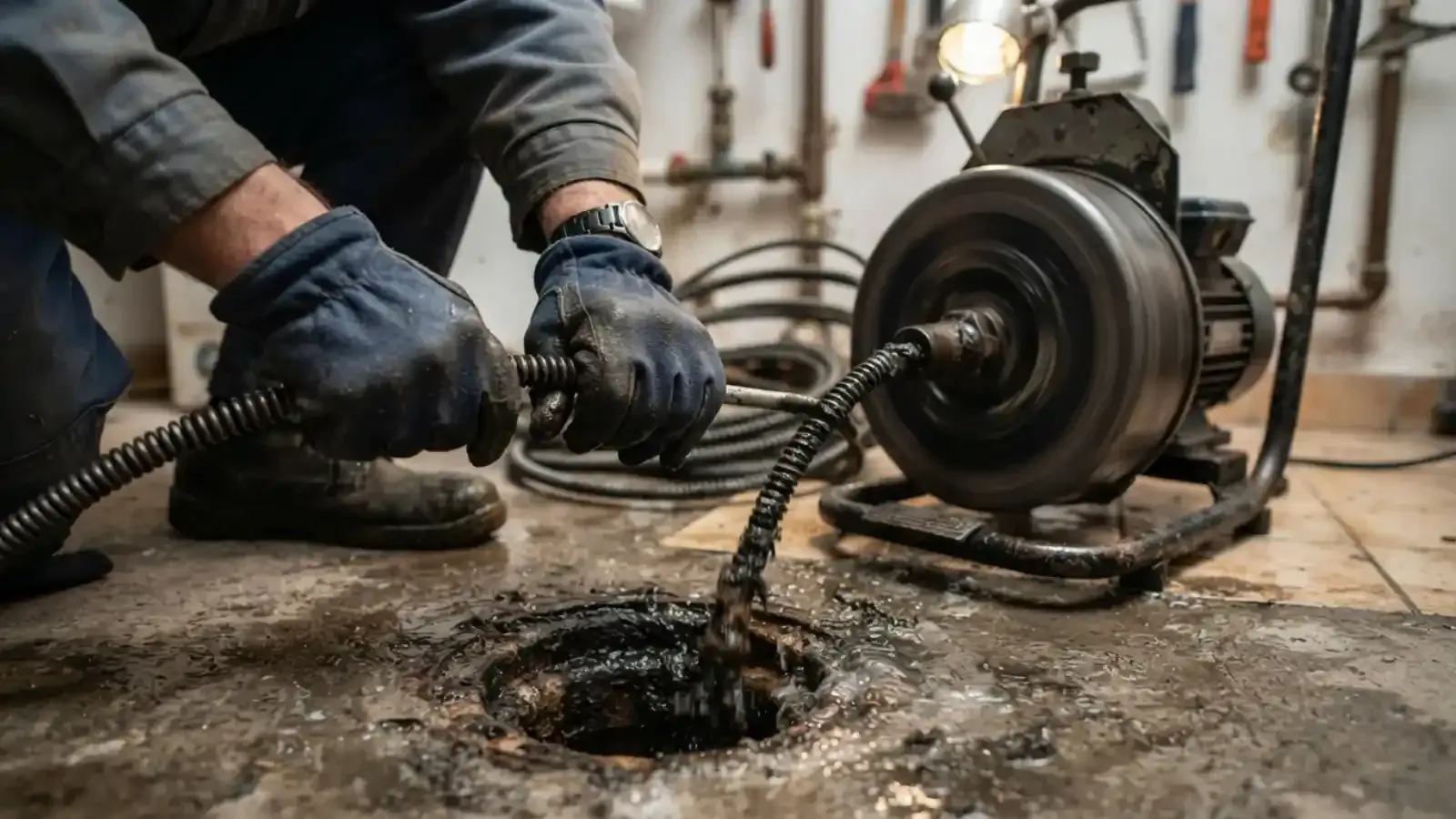
Do not reach for chemical cleaners as a first move. They can damage fittings, create a splash hazard and leave a dangerous residue for whoever opens the drain next. A cleaning with a snake or a hydro-jetting pass removes the whole coating instead of poking a hole through it.
A safe way to test a slow tub
- Remove the stopper and clean hair from the strainer and the first inch of the drain.
- Run hot water for a minute and time how long a few inches take to drain.
- Use a cup plunger over the drain with the overflow plate blocked by a wet rag.
- Test again. If the flow improved, repeat the clean-out monthly.
- Run the sink and the shower next to it to see whether they are also slow.
- If more than one fixture is slow, stop and call a plumber.
The trap and the branch line
Most tub drains connect to a P-trap or a drum trap, which holds a little water to block sewer gas. Hair and soap can build up in that bend. Because the trap sits below the floor or in the wall, you cannot reach it without opening an access panel.
A branch line is the pipe that serves a group of fixtures, often the tub, the bathroom sink and the toilet. If the branch has buildup, all those fixtures drain more slowly. A plumber can clear it from a cleanout or through the tub drain, then run a camera if the problem returns.
Vent problems: when the pipe cannot breathe
Every drain needs air behind the water. A plumbing vent runs from the drain system up through the roof, and it lets air in so the water can flow instead of fighting a vacuum. A blocked vent can make a tub drain slowly, gurgle or pull water out of other traps.
Vent blockages often come from leaves, a bird nest, snow or ice at the roof opening. You can look for a visible obstruction from the ground, but do not climb on a roof to check one. A plumber can clear the vent and confirm the diagnosis with a camera. Gurgling is the clue that sets a vent problem apart from a simple hair clog.
Signs that the main line is involved
A single slow tub is local. Slow drains in more than one place are a bigger signal. If the lowest drains in the house behave worst, such as a basement shower or a first-floor tub, the main line may be partly blocked.
- Toilet gurgles when the tub or washer drains
- Water backs up into a floor drain or lower fixture
- More than one fixture is slow on the same day
- A sewage odor near a floor drain
- Clogs return soon after clearing
If these apply, stop adding water and call a plumber. Our sewer line cleaning service clears the main line, and a sewer camera inspection shows whether roots or a broken pipe are the cause.
Before you call a plumber about a slow tub
- Is only the tub slow, or are other drains slow too?
- Does the tub gurgle as it drains?
- Does the toilet bubble or rise when the tub drains?
- Is the stopper clean and moving freely?
- Has hair or soap been building up for months?
- Have you used chemical cleaner recently?
- Is there a smell of sewage near a drain?
Helena homes and slow tubs
Helena grew from 10,296 people in 2000 to 20,914 in 2020, so most tubs outside Old Town are in homes newer than 1990. Those homes tend to have standard stoppers and straightforward drain layouts, which means hair buildup and stopper trouble are the common causes. That is good news, since those are the easiest to fix.
In Old Town, expect older tubs and drain lines. A slow drain there can point to corrosion inside the pipe as well as buildup, and a camera can tell the difference.
When to call
If the tub is slow and you have cleaned the stopper, tried a plunger and still see no improvement, call a licensed plumber. We serve Helena and nearby towns, including Chelsea, AL and Calera, AL. Call (855) 575-2890 for a visit with a clear price before work starts, and describe which fixtures are slow so we can bring the right tools.
Slow tub drain questions from Helena homeowners
A thin layer of hair and soap can narrow the pipe without sealing it. A plunger clears the top layer, but buildup remains below, so it returns.
Yes. Without air behind the water, the drain sounds gurgly and moves slowly. A plumber can check the vent safely from the roof or with a camera.
Not by itself. If it is the only slow drain, the cause is local. If several drains are slow, the main line needs a look.
We advise against it. It can harm fittings, and a plumber working on the drain later could be splashed. Use a plunger or hand tool first.
Remove it and test the flow without it. If water drains much faster, the stopper or its linkage needs cleaning or adjustment.