
If your water meter keeps moving when every faucet, appliance and fixture in the house is off, you have a leak. It may be inside the house, under the slab, in the yard or in a toilet that runs silently. The meter test below tells you whether a leak exists, and the toilet dye test checks the most common source.
A high bill does not always mean a leak. Watering a lawn, filling a pool, guests, or a longer billing period can all raise it. But a meter that moves with everything off cannot be explained by habits. That is the sign worth acting on.
Why this matters more than it looks
Hidden leaks waste a lot of water. EPA WaterSense reports that the average household loses about 180 gallons per week, roughly 9,400 gallons per year, to leaks. Ten percent of homes leak 90 gallons or more per day, according to the same agency. Most of those leaks are silent.
The leak is also not only a bill problem. Water under a slab can undermine soil, water behind a wall can feed mold, and a leaking line in the yard can wash out the ground over time. Catching it early shrinks all three risks.
Run the meter leak test
You need a few minutes and a quiet house. No one should be using water during the test, and the ice maker, dishwasher, washer and irrigation system should be idle.
The meter leak test
- Turn off every faucet, appliance and irrigation zone, and make sure no one flushes a toilet.
- Find your water meter, usually in a box near the street or the property line. Lift the lid carefully and watch for insects.
- Look at the leak indicator on the dial. It is often a small triangle or a wheel that spins when any water flows.
- If the indicator spins, write down the meter reading or take a photo of it.
- Wait 30 minutes with no water use, then check again.
- If the reading changed or the indicator is still moving, you have a leak.
- Close the main shutoff valve at the house, then recheck the meter. If it stops, the leak is inside the house. If it keeps moving, the leak is in the line between the meter and the house.
Step 7 is the most useful. It splits the problem in two, so you know whether to look inside the home or under the yard.
Check the toilets first
Toilets are the most common silent leak. A worn flapper lets water seep from the tank into the bowl, and the toilet refills in short bursts. You may hear nothing, but the meter notices.
The toilet dye test
- Remove the tank lid and put a few drops of food coloring in the tank. Do not flush.
- Wait 15 to 20 minutes with no one using the toilet.
- Look in the bowl. If color appears, the flapper or fill valve is leaking.
- Flush to clear the dye, and repeat for each toilet in the house.
- If a toilet leaks, replace the flapper or call for toilet repair.
Dye in the bowl with no flush proves a leak. It is also one of the cheapest fixes in plumbing, so check every toilet before you suspect anything larger.
Other usual suspects
If the toilets pass, work through the other places where leaks tend to hide. Some are visible, and some are not.
| Location | Sign | How to check |
|---|---|---|
| Toilet flapper or fill valve | Faint trickle sound, dye in the bowl | Dye test on each toilet |
| Faucets and shower valves | Drips, stains, damp cabinets | Look under sinks and at shower valves |
| Water heater | Wet floor or valve discharge | Check the tank base and relief valve line |
| Irrigation system | Soggy lawn, low pressure in zones | Check zones and backflow device |
| Outdoor spigot or hose bib | Damp soil near the wall | Look for wet ground at the foundation |
| Main line from meter to house | Meter moves with main valve closed | Pressure test or electronic leak location |
| Slab or wall line | Warm floor, damp wall, sound of water | Call a plumber for leak detection |
When the leak is outside or under the slab
If the meter keeps moving after the main shutoff at the house is closed, the leak is on the line from the meter to the home. A green strip in dry weather, a soggy spot in the yard, or lower pressure can all point there. A leak under a slab is quieter but may show up as a warm patch on the floor or a hot water line running when no one uses hot water.
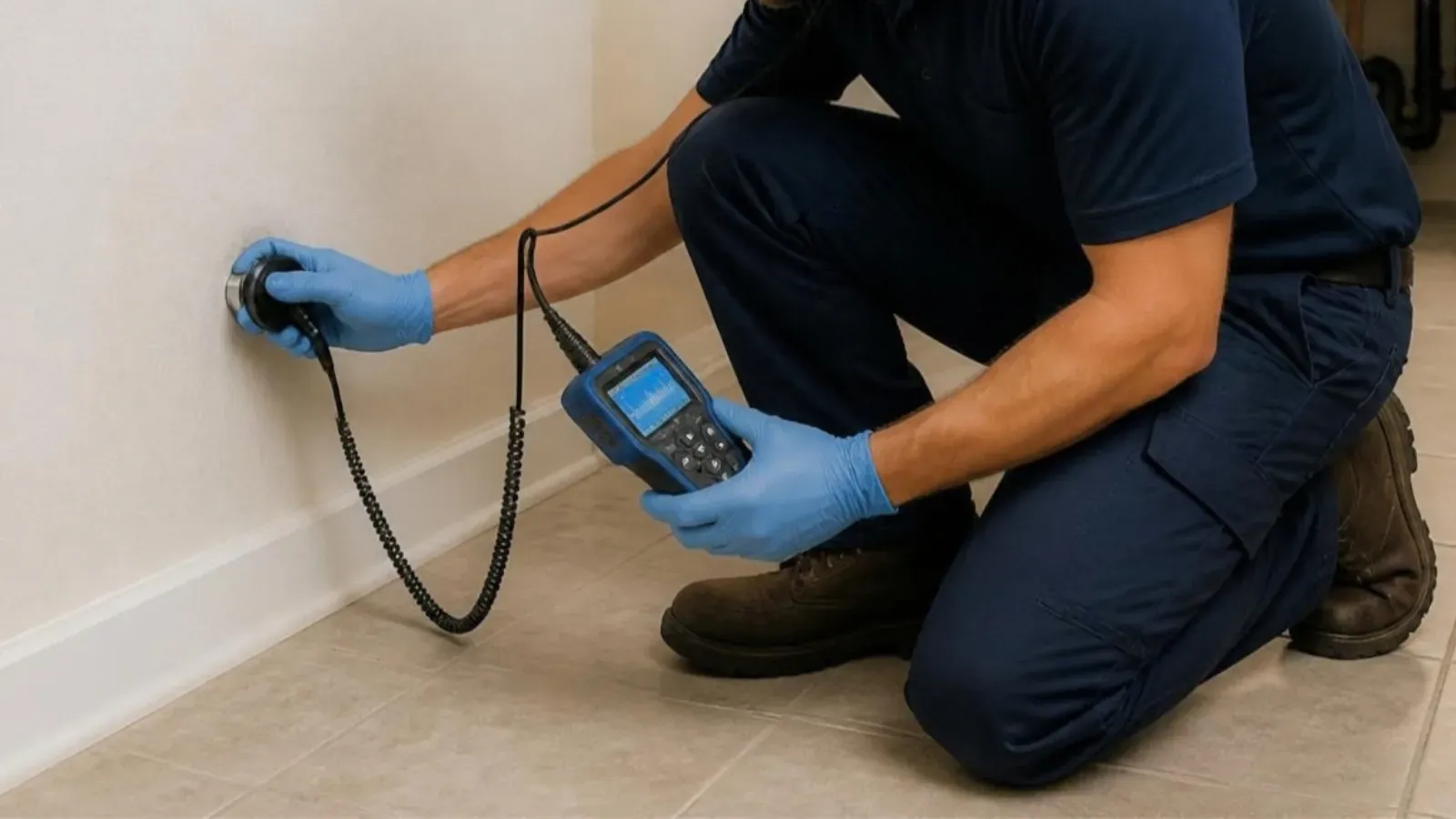
For those cases, a plumber uses acoustic and pressure equipment to find the leak without digging up the whole yard. Our leak detection service does this. If the line itself has failed, water service line repair is the next step, and the choices are repair of a section or a replacement of the whole run.
Reading your bill the right way
Helena water customers get a bill on the 1st of the month, and the utility reads meters mid-month. That means a bill reflects use over a period that does not match the calendar month. Check your bill for the reading dates before you compare one month to another.
If the high bill follows a mid-month reading, a leak that began the week before can still show up as a large jump. Look at the reading dates and the usage amount, then compare with the same period last year. If the usage is up and you cannot explain it, run the meter test.
What to gather before calling the utility or a plumber
- Your latest bill, with reading dates and usage
- Your bills from the past few months for comparison
- The meter reading before and after the test
- Whether the leak indicator was spinning
- Results of the toilet dye test
- Whether the reading stops when the main valve is closed
- Any wet spots, stains or sounds you noticed
Helena homes and hidden leaks
Helena grew from 3,918 people in 1990 to 20,914 in 2020, so most homes outside Old Town are newer than 1990. In newer homes, leaks more often start at fixtures, flappers and irrigation connections than from worn-out pipe, and those are generally easier to find. Toilet flappers and irrigation lines are the likeliest culprits in newer subdivisions.
Older homes in Old Town have had more years of wear on their lines. If your house is older and the meter moves with the main valve closed, ask a plumber to test the line from the meter to the house.
Who to call
If the meter test says you have a leak and the toilets pass, call a licensed plumber and say which side of the main valve the leak is on. We serve Helena and nearby towns such as Pelham, AL and Alabaster, AL. Call (855) 575-2890 for a visit with a clear price before work starts. If water is flooding the house, close the main valve and call at once, day or night.
Water meter and high bill questions from Helena homeowners
If every fixture is off and the indicator still turns, yes, even a slow movement means water is flowing. Run the 30 minute test to confirm.
Meters are read mid-month and bills go out on the 1st. Check your bill for the exact reading dates.
Do the dye test on each toilet. If the toilets pass, close the main valve at the house and watch the meter. If it stops, the leak is inside. If it keeps moving, the leak is on the line to the house.
Yes. Toilet flappers, underground lines and slab leaks can all run unseen. That is why the meter is the best first tool.
Call the plumber for leaks on your side of the meter. Call the City of Helena Utilities Board at (205) 663-1670 for billing questions and for anything on the street side.